
Testosterone Replacement Therapy for Men in Phoenix AZ to Boost Energy and Wellness
At Centra Internal Medicine, Dr. Manish Sahni, MD and our team specialize in restoring hormonal balance for men facing the challenges of low testosterone. We provide a medically supervised environment where patients in Phoenix can access high-quality Testosterone Replacement Therapy (TRT) tailored to their specific laboratory results and lifestyle needs. By focusing on evidence-based protocols, we help our patients reclaim their energy, focus, and physical strength with transparency and professional care. Contact Centra Internal Medicine today or schedule your online consultation. We are located at 6036 North 19th Avenue Suite 502, Phoenix, AZ 85015.
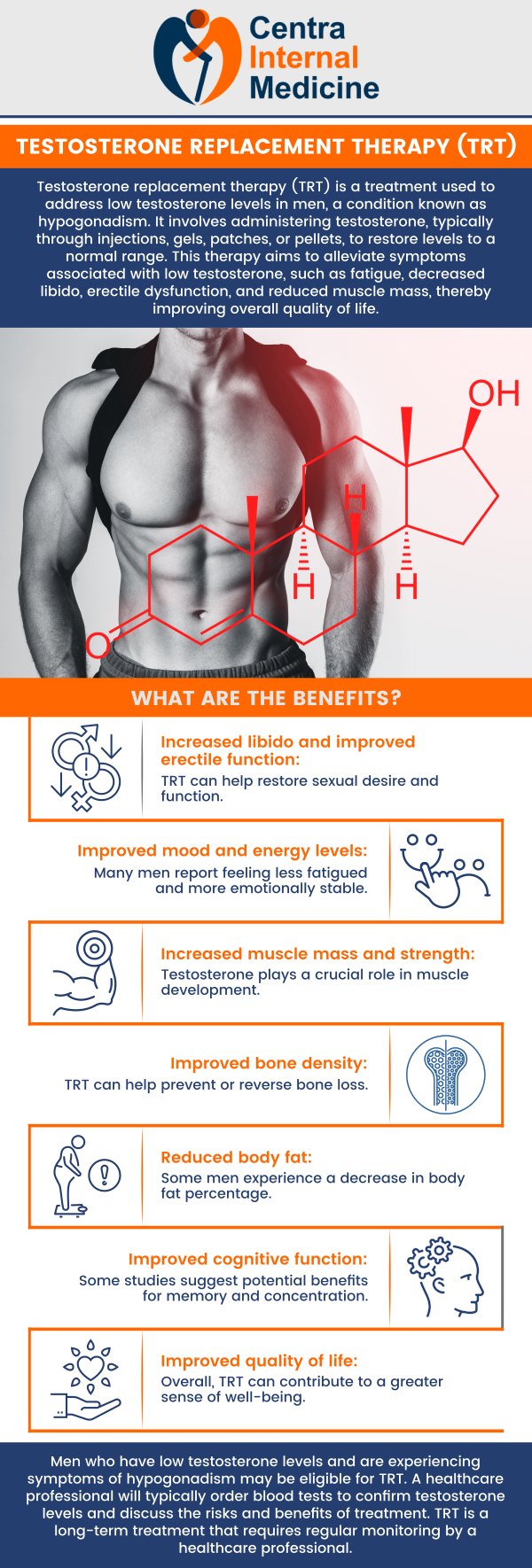
Table of Contents:
What tests will be needed to find out if someone needs Testosterone Replacement Therapy (TRT)?
What is the difference between “Normal” and “Optimal” testosterone levels?
How does TRT support long-term heart and bone health in men?
What should I expect during my initial TRT consultation and blood work?
How does the clinical expertise of Dr. Manish Sahni, MD enhance your TRT results?
Determining the need for TRT requires a comprehensive “snapshot” of your internal chemistry. It is not as simple as checking a single number; a full hormonal profile is necessary to understand why levels might be low.
The primary test is a Total Testosterone lab, which measures the entire amount of testosterone in your bloodstream. However, because much of that hormone is bound to proteins and unavailable for the body to use, we also test for Free Testosterone. Additional essential labs include:
• SHBG (Sex Hormone-Binding Globulin): To see how much hormone is being “trapped” by proteins.
• LH & FSH: Pituitary hormones that tell us if the problem lies in the testes or the brain.
• PSA (Prostate-Specific Antigen): To ensure prostate health before beginning therapy.
• CBC (Complete Blood Count): To monitor red blood cell concentration, which can change during TRT.
The “Normal” range provided by most laboratories is a statistical average based on a broad population, often including men who are elderly or in poor health. For many labs, this range spans from roughly 300 ng/dL to 1,000 ng/dL. A man can technically be “normal” at 310 ng/dL, yet feel the debilitating effects of low energy, brain fog, and muscle loss.
“Optimal” levels, on the other hand, refer to the range where an individual patient feels their best and functions at peak performance. For most men, this is the upper third of the reference range. Under the guidance of Dr. Manish Sahni, MD, the goal is not just to get you “into the range,” but to reach a level that restores your quality of life while maintaining safety and long-term health.
While often discussed in the context of muscle and libido, testosterone is a critical metabolic hormone. For the skeletal system, testosterone is essential for bone mineral density. Men with chronic low-T are at a significantly higher risk for osteoporosis and fractures. TRT helps stimulate bone-building cells, strengthening the frame as you age.
Regarding heart health, research suggests that maintaining testosterone within an optimal range can improve insulin sensitivity and reduce visceral fat—two major risk factors for cardiovascular disease. Testosterone also aids in the health of the vascular endothelium (the lining of the blood vessels). By improving body composition and metabolic markers, TRT serves as a preventative tool for long-term vitality.
Your journey begins with a detailed clinical interview. During your first visit, we discuss your symptoms, such as fatigue, mood changes, or decreased physical stamina, alongside your medical history. Following this, we perform a physical exam and order the specific blood panels mentioned above.
Blood work for testosterone is time-sensitive; it must be drawn early in the morning (usually before 10:00 AM) when levels are at their natural peak. Once the results are in, you will meet with the medical team to review the data. If a deficiency is confirmed, we discuss various administration methods—such as injections, gels, or pellets—to find the one that fits your lifestyle.
Personalized care is the hallmark of the treatment provided by Dr. Manish Sahni, MD. Unlike “cookie-cutter” clinics that focus solely on hormones, Dr. Sahni treats TRT as a component of your total internal medicine profile. He takes the time to analyze your cardiovascular health and metabolic markers to ensure that therapy is improving your longevity, not just your lab numbers. At our clinic, you aren’t just a patient; you are a partner in a medical strategy designed to help you age with vitality, mental clarity, and physical strength through expert physician oversight.
Low testosterone doesn’t have to be a permanent drain on your wellness. Whether you are struggling with midday crashes or a loss of motivation, our team is here to provide the clinical expertise you deserve. Visit Centra Internal Medicine for a comprehensive consultation and find out if a customized TRT plan is the right path for your health journey. Contact Centra Internal Medicine today or schedule your online consultation. We are located at 6036 North 19th Avenue Suite 502, Phoenix, AZ 85015. We serve patients from Phoenix AZ, Glendale AZ, Scottsdale AZ, Peoria AZ, Tempe AZ, and surrounding areas.
Check Out Our 5 Star Reviews


Additional Services You May Need
▸ Aesthetics
▸ Allergies
▸ Annual Physical Exams
▸ Gynecological Exams
▸ High Blood Pressure
▸ Immunizations
▸ Joint Injections
▸ Lab Services
▸ Migraines
▸ Minor Surgical Procedures
▸ Pre-op Clearance Exams
▸ Double Chin
▸ Acute Disease Management
▸ CDL Physical Exam
▸ Tirzepatide
▸ Phentermine
▸ Nutritional Coaching
▸ DOT Physicals
▸ FDA-Approved Oral Semaglutide (GLP-1)

Additional Services You May Need
▸ Aesthetics
▸ Allergies
▸ Annual Physical Exams
▸ Gynecological Exams
▸ High Blood Pressure
▸ Immunizations
▸ Joint Injections
▸ Lab Services
▸ Migraines
▸ Minor Surgical Procedures
▸ Pre-op Clearance Exams
▸ Double Chin
▸ Acute Disease Management
▸ Mole Removal
▸ Primary Care
▸ Same Day Appointments
▸ Sculpsure
▸ Sick Visits
▸ Wound Care
▸ TempSure
▸ Testosterone Replacement Therapy
▸ Telemedicine
▸ Weight Management
▸ Wellness
▸ Women’s Health
▸ Chronic Disease Management
▸ CDL Physical Exam
▸ Auto Accident Injury
▸ Tirzepatide
▸ Semaglutide
▸ Phentermine
▸ Contrave
▸ Nutritional Coaching
▸ DOT Physicals
▸ Vaccinations
▸ FDA-Approved Oral Semaglutide (GLP-1)


 Send Text
 How May I Help You?